The True Ledger: A Lifetime Accounting of Bespoke Versus Disposable Dress
There is a number that most Americans never calculate. It lives quietly in credit card statements, buried beneath line items for groceries and streaming subscriptions, accumulating without ceremony or acknowledgment. It is the total amount spent on clothing over a lifetime—and for the average American consumer, it is far larger, and far less satisfying, than anyone cares to admit.
The Bureau of Labor Statistics estimates that the average American household spends roughly $1,700 to $1,900 annually on apparel. Over twenty years, that figure approaches $38,000. Over a working lifetime of forty years, it climbs past $70,000. What does that expenditure produce? For most households, it produces a closet in perpetual flux—crowded, yet offering nothing adequate to wear—a wardrobe built from impulse rather than intention, and a recurring tax on time, energy, and self-possession.
The question worth asking is not whether bespoke clothing is expensive. The question is: expensive compared to what?
The Hidden Architecture of Fast Fashion's True Cost
Disposable fashion does not present its costs honestly. A $40 blouse appears, on its surface, to be a bargain. What it conceals is the replacement cost incurred when it pills after six washes, the alteration fee paid because its proportions fit no actual human body with precision, and the psychological toll of wearing something that communicates carelessness rather than confidence.
Consider the mathematics more carefully. A consumer who purchases ten moderately priced garments per season—a conservative estimate for someone engaged with contemporary retail culture—spends approximately $4,000 to $6,000 annually when accessories, footwear, and seasonal refreshes are included. Many spend considerably more. Over twenty years, this pattern of acquisition and disposal generates between $80,000 and $120,000 in expenditure, often yielding a wardrobe that, at any given moment, contains perhaps a dozen pieces the wearer genuinely values.
The hidden costs compound further. Off-the-rack garments are engineered for a statistical average body, not a specific one. The American Tailors Guild has long noted that fewer than twelve percent of men and fewer than eight percent of women can wear ready-to-wear clothing without requiring at minimum minor alterations. Those alterations—hemming trousers, taking in a waist, shortening sleeves—carry their own costs, ranging from $15 for a simple hem to $200 or more for structural adjustments. Multiply these interventions across a wardrobe built over two decades, and the figure is not trivial.
What a Bespoke Wardrobe Actually Costs—and Produces
A well-reasoned bespoke wardrobe, built deliberately over time, operates on an entirely different financial logic. Consider a client who commissions six to eight foundational pieces over the course of five years: two suits, a formal coat, three shirts, a pair of trousers, and a structured jacket. At an American atelier of serious craft, this investment might total between $12,000 and $22,000 depending on cloth selection and complexity.
Those garments, maintained with appropriate care, will serve their owner for fifteen to twenty-five years. The cost-per-wear calculation, applied honestly, often renders the bespoke piece less expensive per use than its ready-to-wear counterpart. A $3,500 suit worn 150 times over twelve years costs less than $24 per wearing. A $400 suit that fits poorly, requires $180 in alterations, and is retired after eighteen months of infrequent use tells a very different story.
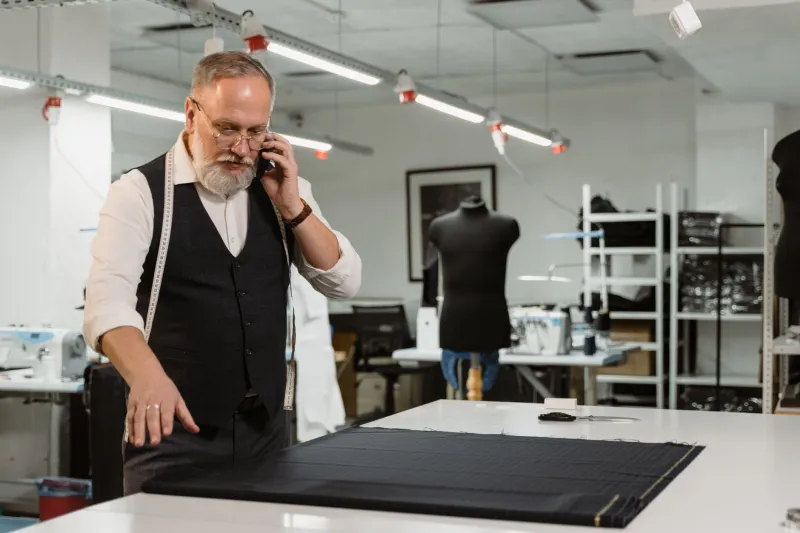
Furthermore, a bespoke garment requires no tailoring upon delivery. It is made for one body, one set of proportions, one aesthetic intention. The fitting process—the series of appointments that define bespoke production at studios like Williamson & Curran—eliminates the remediation costs that off-the-rack purchasing demands as a matter of course.
The Decision Fatigue Dividend
There is a cost that defies easy quantification but is no less real for that: the cognitive and emotional weight of a wardrobe that does not function coherently. Behavioral economists have documented the phenomenon of decision fatigue extensively—the depletion of mental resources that accompanies an excess of choices. A closet containing eighty garments of varying quality, fit, and relevance demands more of its owner each morning than a wardrobe of thirty pieces, each selected with deliberate purpose.
Clients who have transitioned from high-volume retail consumption to a curated bespoke wardrobe frequently describe a profound reduction in what might be called wardrobe anxiety. When every garment fits correctly, communicates intentionally, and serves a defined role within a coherent aesthetic, the act of dressing becomes efficient rather than exhausting. The time recovered—even conservatively estimated at ten minutes per day—amounts to more than sixty hours annually.
The Resale Consideration
Bespoke garments, particularly those made from superior cloth by respected makers, retain and sometimes appreciate in value in ways that fast fashion cannot. Vintage bespoke pieces from notable American and British tailors regularly command significant sums at auction and through specialist resellers. While no responsible financial advisor would suggest commissioning clothing as a primary investment vehicle, the residual value of quality bespoke work is not negligible, and it stands in stark contrast to the zero resale value of the average contemporary retail purchase.
Reframing the Conversation
The studio has long maintained that the conversation about bespoke clothing must be reframed—not as a discussion of luxury versus practicality, but as a discussion of two distinct financial philosophies applied to dress. One philosophy prioritizes low entry cost and accepts high total cost, frequent replacement, and diminishing satisfaction. The other accepts a higher entry cost in exchange for durability, precision, and the compounding returns of a wardrobe built to last.
The unfashionable truth, supported by any honest accounting, is that the second philosophy is frequently the more economical one. The numbers, examined with clarity and without sentiment, favor the maker's room over the mass-market floor. What they also favor—and what no spreadsheet can fully capture—is the particular dignity of wearing something made entirely for you, by hands that understood precisely what you required.