The Virtue of Waiting: How Discerning Clients Are Reclaiming Time as a Design Tool
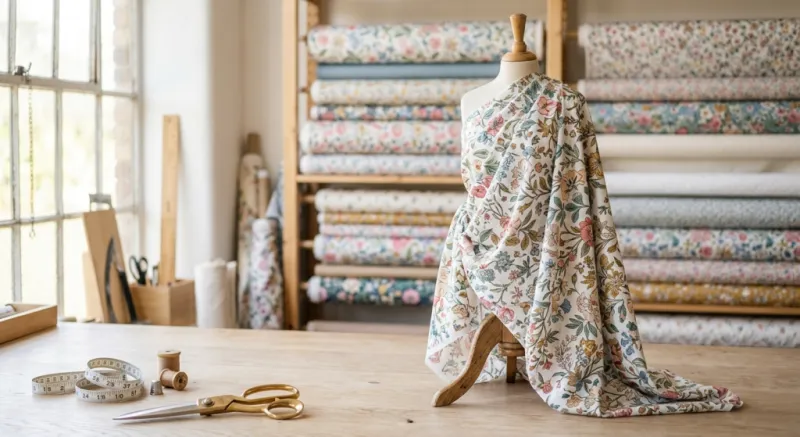
Photo: tailor carefully measuring fabric in sunlit atelier studio, via globalfabricwholesale.com
Consider the paradox at the center of contemporary consumption: we have engineered the world to deliver almost anything within hours, and yet the things we value most — the relationships, the skills, the objects worth keeping — almost always require the one resource our systems cannot manufacture. Time, it turns out, is not a problem to be solved. For the most discerning clients commissioning bespoke work today, it has become a feature to be requested.
Across ateliers in New York, Chicago, Los Angeles, and beyond, a notable shift is underway. Clients who could afford expedited service are not asking for it. They are, in growing numbers, requesting the opposite — commission timelines stretching from six months to a year or more, built not out of necessity but out of genuine conviction that the waiting is part of what makes the work worth having.
Speed as a Symptom
To understand why this shift matters, it helps to understand what it is reacting against. The acceleration of fashion production over the past two decades has not merely changed what clothing costs or how long it lasts. It has changed the cultural meaning of clothing itself. When a garment can be conceived, manufactured, shipped, and discarded within weeks, it becomes difficult to assign it any significance beyond the transactional.
The clients who seek out bespoke work are, by definition, opting out of that cycle. But even within the world of custom clothing, the pressure toward speed has made itself felt. Rush orders, expedited fittings, compressed consultations — the infrastructure of impatience has encroached on spaces that once operated according to a very different rhythm.
The deliberate rejection of that pressure, then, is not merely a personal preference. It is a statement about what kind of relationship one wishes to have with the objects one wears — and with the people who make them.
Time as Collaboration
The practical benefits of an extended timeline are not incidental. They are, in fact, central to why the resulting work tends to be better.
A commission undertaken across six months or more allows for a quality of creative dialogue that compressed schedules simply cannot accommodate. Early conversations about a garment's purpose, its materials, its relationship to the rest of a wardrobe — these benefit from the opportunity to pause, reconsider, and return. A client who sleeps on a fabric choice for three weeks and comes back with a different instinct is not being indecisive. They are being thoughtful. And the garment, ultimately, reflects that thoughtfulness.
For the maker, an extended timeline unlocks possibilities that rush work forecloses entirely. Sourcing materials with genuine integrity — tracking down a specific weight of English wool from a mill that produces limited yardage, or locating a lining cloth that has been discontinued but can occasionally be found through specialist merchants — requires time that cannot be manufactured after the fact. Some of the most exceptional cloth in circulation today is not available on demand. It must be found, and finding it is a process that rewards patience.
The Anticipation Economy
There is a psychological dimension to extended timelines that deserves honest examination. The act of waiting for something one genuinely desires has a well-documented effect on how that thing is ultimately experienced. Anticipation is not merely the absence of gratification; it is a form of engagement. A client who has spent months thinking about a coat — imagining how it will wear, revisiting swatches, discussing construction details across multiple conversations — arrives at the final fitting with a depth of investment that instant delivery cannot replicate.
This is not nostalgia for its own sake. It is a recognition that meaning accrues through attention, and attention requires time. The most significant garments in any serious wardrobe tend to be those whose acquisition involved some form of sustained effort. They are worn differently, cared for differently, and held onto far longer than objects acquired without friction.
Some clients describe the extended commission period as a kind of ongoing relationship with a garment that does not yet exist — a process of becoming acquainted with something before it arrives. That relationship, once established, tends to persist well beyond the delivery date.
Resisting the Reflex
For clients accustomed to the rhythms of modern commerce, requesting a longer timeline can feel counterintuitive at first. There is a residual anxiety that equates speed with seriousness, as though the maker who delivers quickly is somehow more capable than one who insists on taking the time the work requires. That anxiety, where it exists, is worth examining and setting aside.
The ateliers that produce the most enduring work are, almost without exception, those that refuse to compress their process. The commitment to a timeline grounded in craft rather than convenience is not a limitation — it is a signal. It tells the client something important about the standards being applied to their commission.
At The Studio of Williamson & Curran, we have always understood that the relationship between a client and their maker is one of the more unusual partnerships available in contemporary life. It asks for trust, for candor, and — increasingly — for a willingness to resist the reflexive demand for immediacy. The clients who bring that willingness to their first consultation tend to leave with something more than a garment. They leave with a piece of work that carries the full weight of the time and attention that made it possible.
An Investment in What Endures
The broader cultural moment may, in fact, be more receptive to this argument than it has been in decades. There is a growing appetite, particularly among Americans who have spent years navigating the exhaustions of constant consumption, for objects and experiences that ask something of them in return. The willingness to wait — to allow a commission to unfold across seasons, to let the creative process breathe — is, in this light, less a sacrifice than an act of alignment.
To dress well, in the deepest sense, has never been about acquiring quickly. It has been about choosing deliberately, building slowly, and wearing with the knowledge that what one owns was made with care proportional to the care with which it will be kept.