Cultivating the Eye: Transmitting Aesthetic Judgment Across Generations

There is a particular kind of wealth that no estate attorney can itemize. It does not appear on an inventory of possessions or appreciate on any financial ledger. It lives, instead, in the way a person enters a room — in the quiet authority of a well-chosen cloth, the considered fall of a lapel, the unhurried deliberateness with which a garment was commissioned and worn. This is the inheritance of aesthetic judgment, and it may be the most consequential thing a discerning dresser ever bequeaths.
At The Studio of Williamson & Curran, we have observed that the clients most deeply invested in bespoke work are rarely thinking only of themselves. Increasingly, they arrive with a secondary purpose: to transmit something essential to a son, a daughter, a protégé, or a younger colleague who is beginning to move through the world in earnest. The question they carry is not merely what do I leave behind? but how do I teach someone to see?
What Taste Actually Is — and Why It Cannot Be Gifted Whole
Taste is frequently misunderstood as a fixed attribute — something one either possesses or lacks. In reality, it is closer to a practice, a form of sustained attention that is built through exposure, failure, reflection, and revision. The client who arrives at a bespoke commission with genuine clarity has almost certainly spent years making choices, living with them, and slowly calibrating their instincts against accumulated experience.
This is precisely why taste cannot be handed over intact, the way one might transfer a piece of property. A young person given access to a distinguished wardrobe without the philosophy that produced it is holding a text in a language they have not yet learned. The garments may inspire admiration, but the deeper logic — why this fabric and not that one, why this silhouette for this occasion, why restraint here and expression there — remains opaque without patient instruction.
The most effective transmission of aesthetic sensibility, then, is not declarative. It is experiential.
The Commission as Classroom
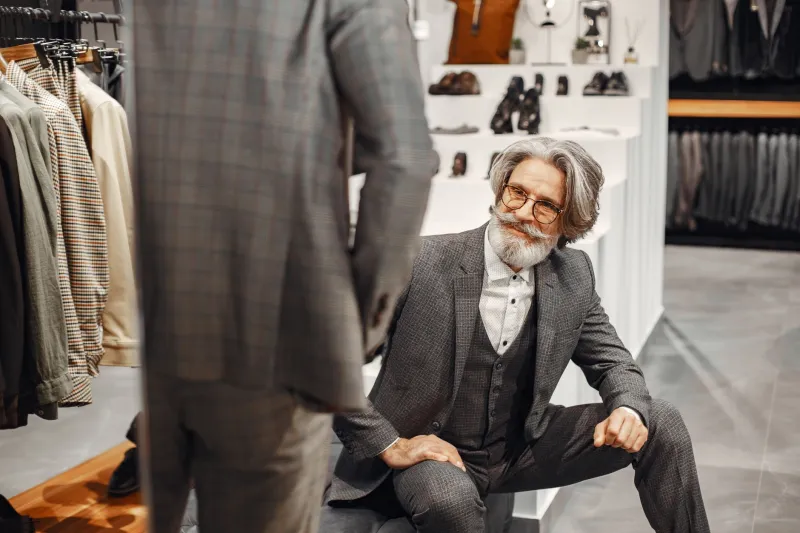
One of the most powerful tools available to a mentor is the shared commissioning experience. Bringing a younger family member or protégé into the process of designing a garment — not as a passive observer, but as an active participant — exposes them to a form of decision-making that is rarely taught in any formal setting.
Consider what a single bespoke commission contains: a conversation about occasion and context, a negotiation between personal preference and practical constraint, a series of choices about fiber and weight and construction that carry real consequence. When a mentor walks someone through these decisions aloud — explaining not just what they are choosing but why, and inviting the younger person to question and push back — the commission becomes a structured lesson in intentional thinking.
The key is narration. The experienced client who has long internalized their aesthetic philosophy must make the implicit explicit. Why does a heavier wool serve better here than a lighter one? What does this particular shade of navy accomplish that a brighter tone would not? These may seem like small questions, but they are the building blocks of a disciplined eye.
Curating Exposure Without Prescribing Outcomes
Transmitting taste across generations requires a careful balance between guidance and freedom. The goal is not to replicate one's own sensibility in another person — that produces imitation, not genuine discernment. The goal is to cultivate the capacity to make deliberate choices that are authentically one's own.
This means that exposure should be broad and varied. A young person developing their aesthetic vocabulary benefits enormously from visits to well-made collections across different traditions — American tailoring, European atelier work, the craft textile traditions of the American Southwest and New England. They benefit from understanding what quality construction actually feels like in the hand, from learning to distinguish between garments made to last and garments made to sell.
It also means resisting the impulse to correct too quickly. When a younger person makes an aesthetic choice that a mentor would not have made, the more valuable response is curiosity rather than redirection. Tell me what drew you to that opens a conversation that I wouldn't have chosen that forecloses entirely.
The Discipline of Waiting and Wanting
Perhaps the most countercultural lesson a mentor can offer in the present moment is the value of restraint. In an era defined by instant access and disposable consumption, the bespoke tradition insists on a different relationship with time and desire. A commission takes months. It requires patience. It demands that the client know themselves well enough to commit to a vision before it is realized in cloth.
Teaching a younger person to sit with wanting — to resist the immediate acquisition in favor of the considered one — is itself an act of profound mentorship. It is a lesson that extends well beyond dress. The ability to defer, to refine, to wait for the thing that is truly right rather than settling for the thing that is merely available: this is a form of self-knowledge with applications in every domain of a well-lived life.
Legacy as Living Practice
The most lasting aesthetic inheritances are not archives. They are habits of mind. The clients who have most successfully transmitted their sensibility to the next generation are not those who left behind the most impressive wardrobes, but those who modeled, consistently and over time, what it looks like to dress with intention.
They asked questions in front of their children. They explained their reasoning. They returned to certain makers year after year and spoke about those relationships with genuine regard. They treated the act of commissioning not as a transaction but as a form of collaboration — one that required care, preparation, and mutual respect.
In doing so, they offered something that no finished garment can convey on its own: a way of moving through the world that values craft, honors the labor of skilled hands, and insists that the things we choose to wear are worth choosing well.