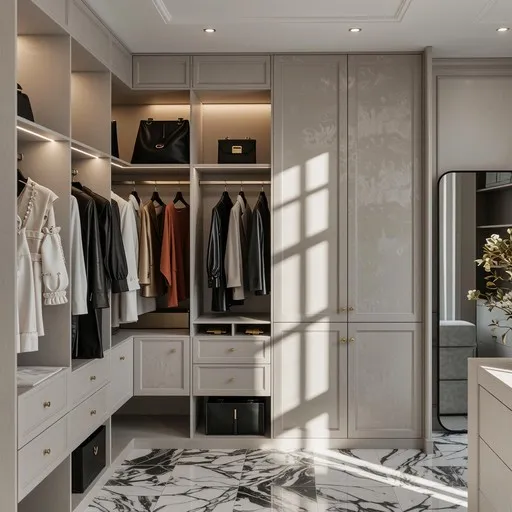
Dressed for the Long Arc: The Case for Building a Wardrobe Across Decades, Not Seasons
At some point, a certain kind of dresser stops thinking in seasons and starts thinking in years. The shift is subtle at first—a growing discomfort with the churn of trend cycles, a dawning awareness that the most admired pieces in the closet are the ones purchased years ago with careful deliberation rather than seasonal impulse. Eventually, this realization crystallizes into something more purposeful: the decision to build a wardrobe not for the moment, but for the arc.
This is not nostalgia. It is maturity.
The Difference Between Accumulation and Collection
Most Americans accumulate clothing. Relatively few collect it. The distinction matters enormously.
Accumulation is reactive—driven by occasion, by sale, by the persistent suggestion that one's existing wardrobe is somehow insufficient. It produces closets full of garments with no coherent relationship to one another, pieces that represent fleeting enthusiasms rather than sustained conviction. The accumulated wardrobe is, almost by definition, a record of distraction.
A collected wardrobe, by contrast, is the product of intention. Each piece has been chosen with an awareness of what already exists, what is genuinely needed, and how a new commission or acquisition will function within the larger whole. Over time, a collected wardrobe develops its own internal logic—a visual and tactile coherence that reflects the wearer's evolving sensibility with remarkable precision.
Bespoke design is uniquely suited to this kind of intentional accumulation. When a garment is made specifically for one person's body, lifestyle, and aesthetic preferences, it enters the wardrobe as a considered addition rather than a speculative purchase. It belongs there in a way that off-the-rack pieces rarely do.
Clothing as Personal Archive
There is a version of dressing that treats clothing as purely functional—as a daily solution to the practical problem of being dressed. And there is another version that recognizes garments as carriers of memory, identity, and personal history.
A coat commissioned at forty, worn through winters that span career transitions, family milestones, and the gradual refinement of one's own sense of self, accumulates a significance that no amount of retail therapy can manufacture. It becomes part of the autobiography. The same is true of a well-made suit, a signature jacket, a dress constructed to mark a particular chapter of life and worn through many that followed.
At Williamson & Curran, clients are encouraged to think of their bespoke commissions in these terms—not as individual transactions but as contributions to a personal archive. The question asked during the design process is not only "What do you need for this occasion?" but "Where does this piece belong in the story of how you dress?"
That reframing changes everything about how a garment is conceived.
How Style Evolves—and Why Your Wardrobe Should Too
The person you are at thirty-five is not the person you were at twenty-five, and the wardrobe that served you then should not be expected to serve you now without significant revision. This is not a failure of those earlier choices. It is simply the natural consequence of a life being lived with genuine engagement.
Style matures. Priorities shift. The silhouettes that once felt right begin to feel like costumes from a previous chapter, while new proportions and palettes emerge that feel more accurately aligned with who one has become. A wardrobe built for the long arc accommodates this evolution rather than resisting it.
Bespoke design provides the mechanism for this accommodation. Because each piece is made to specification, it can be calibrated not only to the body as it currently exists but to the life stage the wearer is currently inhabiting. A commission for a client entering a period of significant professional visibility will be approached differently from one made for the same client a decade later, when the emphasis may have shifted from projection to authority, from arrival to ease.
This kind of longitudinal thinking is one of the defining advantages of working with a bespoke atelier over the course of years rather than for a single occasion.
The Economics of the Long View
The argument against bespoke investment dressing is almost always made on the basis of cost. The argument for it is almost always made on the basis of value—and the distinction between those two concepts is exactly where the case for the lifetime wardrobe is most clearly won.
A garment that costs significantly more than its ready-to-wear equivalent but remains in active rotation for fifteen years, requires minimal replacement, and retains its structural integrity through repeated wear and careful maintenance is not an expensive garment. It is an economical one. The per-wear cost of a well-constructed bespoke piece, calculated honestly over its useful life, frequently compares favorably to the accumulated expense of replacing lower-quality alternatives every two or three seasons.
More to the point, the lifetime wardrobe is not assembled all at once. It is built gradually, with each commission representing a deliberate addition to an evolving whole. The investment is distributed across years, even decades, in a manner that is manageable for most clients who prioritize quality over volume.
Beginning the Wardrobe That Lasts
The lifetime wardrobe begins with a single decision: to value depth over breadth, permanence over novelty, and personal coherence over seasonal relevance. It begins, in other words, with the understanding that the most powerful thing a wardrobe can do is reflect, with increasing accuracy, the person who wears it.
At Williamson & Curran, that understanding informs every commission we undertake. We are not in the business of dressing people for a season. We are in the business of helping people dress for their lives—for the full, unfolding, beautifully specific arc of them.
The wardrobe that results from that approach is not merely a collection of clothes. It is a record of a life lived with intention. And that, ultimately, is what distinguishes the truly well-dressed from the merely well-outfitted.