The Curated Life: Why America's Most Discerning Dressers Are Choosing Depth Over Volume
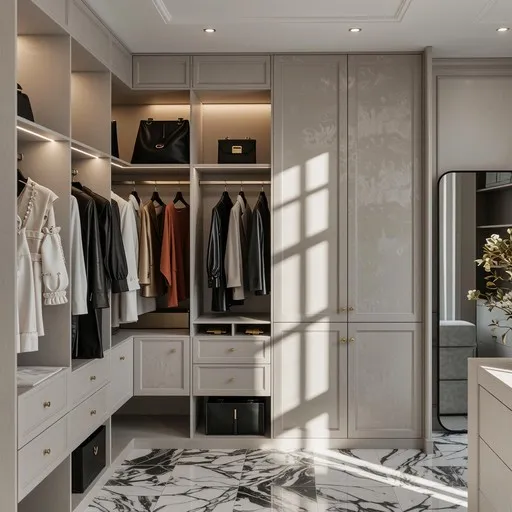
Photo: elegant organized luxury wardrobe closet curated clothing natural light minimal, via images.stockcake.com
Consider, for a moment, the wardrobe as autobiography. Every garment within it represents a decision — a set of values expressed in cloth, color, and construction. For much of the past three decades, the dominant narrative in American fashion has encouraged those decisions to be made rapidly, frequently, and with relatively little deliberation. The results have been, by almost any measure, unsatisfying.
A quieter story, however, has been unfolding alongside the noise of trend culture. Across the country, a particular kind of client has been reaching a different conclusion: that a wardrobe built on a foundation of singular, expertly crafted pieces — chosen with care and worn with conviction — offers something that seasonal consumption simply cannot. Call it the curated life. It is, in every meaningful sense, the opposite of fast fashion.
The Problem with Plenty
The economics of fast fashion have always rested on a peculiar logic: that more is inherently better, and that novelty is inherently satisfying. Neither proposition holds up well under scrutiny. The average American purchases significantly more clothing today than at any previous point in history, yet surveys consistently indicate that most people feel they have nothing to wear — a paradox that reveals something essential about the difference between quantity and resonance.
A closet crowded with disposable garments does not feel abundant. It feels cluttered, indecisive, and faintly exhausting. Each item competes for attention without earning it. Nothing holds particular meaning because nothing was chosen with sufficient deliberation to acquire any.
The curated wardrobe operates on an entirely different premise. It begins not with acquisition but with discernment — a willingness to ask harder questions before bringing anything new into one's life. What purpose will this serve? How does it relate to what already exists? Does it reflect something true about who I am, or only something aspirational about who I imagine I might become?
The Financial Case for Investment Dressing
The notion that bespoke and high-quality investment pieces are financially extravagant is worth examining with some precision. On a per-item basis, a garment crafted by an independent atelier will, of course, carry a higher price point than its mass-market equivalent. But cost-per-wear — a more honest accounting of value — tells a different story.
A bespoke jacket, constructed from exceptional material and fitted with exacting care, may reasonably be expected to last twenty years or more. Worn conservatively fifty times per year, that jacket accumulates a thousand wearings over its lifetime. The arithmetic, when worked through honestly, tends to surprise those who have not previously considered it. The supposedly affordable alternative, replaced every two or three seasons, is frequently the more expensive choice — and the less satisfying one in every other respect as well.
Beyond the financial calculus, there is the question of what investment pieces do to the overall coherence of a wardrobe. A small number of genuinely excellent garments creates a foundation from which everything else can be organized. Getting dressed becomes less effortful, not more, because every available option has been chosen with intention and works in concert with the others.
The Environmental Dimension
The environmental consequences of disposable fashion are by now sufficiently well documented to require only brief acknowledgment here. Textile waste constitutes one of the more significant contributors to landfill volume in the United States, and the production processes associated with fast fashion carry environmental costs that extend well beyond the garments themselves.
The bespoke and investment-dressing model offers a meaningful alternative — not as a form of environmental virtue signaling, but as a structural correction. When garments are made to last, they do not need to be replaced. When they are made to fit a specific person, they are far less likely to be discarded. The environmental benefits of this approach are not incidental; they are built into the philosophy itself.
Furthermore, independent ateliers and design studios tend to work within supply chains that are considerably more transparent than those of large fashion conglomerates. Knowing where a fabric was woven, and by whom, and under what conditions, is not a trivial matter for clients who have given serious thought to what they wear and why.
The Emotional Architecture of a Personal Archive
Perhaps the least discussed, and most significant, dimension of investment dressing is the emotional one. A wardrobe built over time from pieces chosen with genuine care takes on a quality that can only be described as personal. Each garment carries with it the memory of its acquisition, the context of its creation, the relationship with the maker who produced it.
This is what distinguishes a personal archive from a mere collection of clothes. An archive has depth. It tells a story. It reflects the evolution of a sensibility over time, documenting who its owner has been and gesturing toward who they intend to become.
Clients who have spent years building this kind of wardrobe in collaboration with a trusted design studio often describe the experience in terms that have little to do with fashion in the conventional sense. They speak of clarity, of confidence, of a settled relationship with their own appearance that frees them to direct their attention elsewhere. The wardrobe, having been resolved, ceases to be a source of daily anxiety and becomes instead a reliable foundation.
Partnering with a Studio: Where to Begin
For those who are drawn to this philosophy but uncertain how to begin, the practical starting point is simpler than it might appear. It begins with an honest inventory — not of what one owns, but of how one actually lives. What environments does one move through regularly? What demands does daily life make on one's wardrobe? What pieces, if they existed in precisely the right form, would be reached for consistently and with genuine pleasure?
The answers to these questions form the brief that a skilled design studio can work from. A good studio does not impose a vision; it draws one out. The initial conversations are investigative rather than prescriptive, oriented toward understanding the client's life before proposing any solutions to it.
At The Studio of Williamson & Curran, this process of discovery is where our work with clients begins in earnest. We believe that a personal archive built correctly — slowly, deliberately, in genuine partnership between maker and wearer — becomes something far more than a wardrobe. It becomes an expression of a life considered and lived with intention.
The Singular Piece as a Statement of Values
Ultimately, the shift toward investment dressing and personal curation reflects something larger than a change in purchasing behavior. It reflects a reorientation of values — a decision to prioritize depth over breadth, meaning over novelty, and enduring quality over momentary relevance.
In a cultural moment that often prizes volume and velocity above all else, the choice to build slowly and thoughtfully is itself a form of distinction. The client who arrives at this understanding does not simply dress differently. They think differently about what it means to be a patron of craft, a steward of quality, and a person who has taken the time to understand what, precisely, they wish to communicate to the world.
That understanding, once arrived at, tends to be permanent. And the wardrobe built from it tends to be, in the most meaningful sense of the word, timeless.